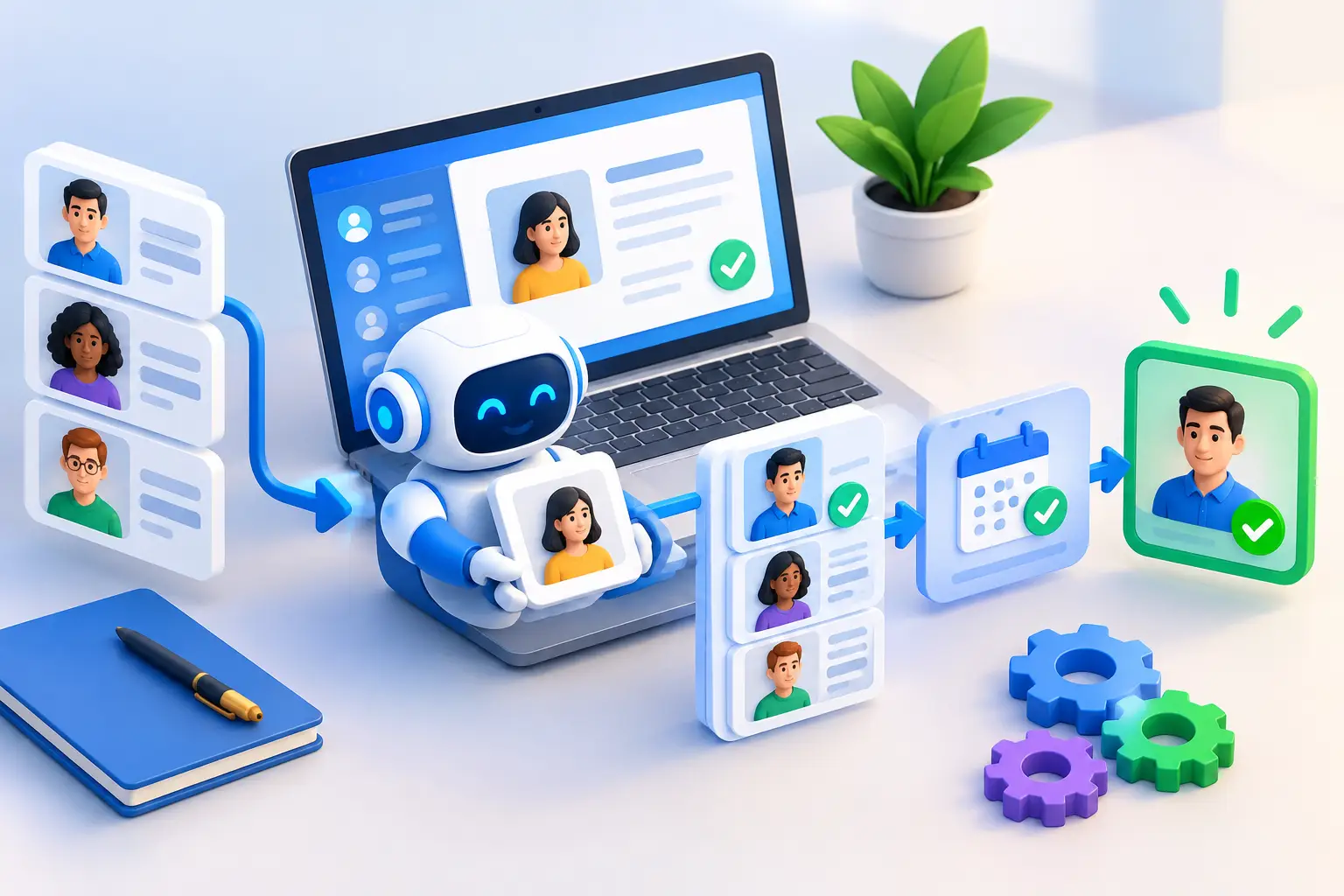
A hiring team can receive 500 applications for one open role before lunch. The issue is rarely a lack of candidates. It is the delay between receiving a CV, understanding whether the person meets the real requirements, confirming the details, and getting a qualified candidate onto a hiring manager's calendar. Recruitment workflow automation software closes that gap by turning disconnected recruiter tasks into one controlled operating flow.
The difference matters most when volume is high and timing is tight. A recruiter should not spend the day copying CV details into an ATS, calling candidates who miss a deal-breaker, chasing compensation expectations, or trading emails to find a 30-minute interview slot. Those are repeatable operational steps. They can be automated while recruiters retain control over hiring judgment, candidate experience, and final decisions.
What Recruitment Workflow Automation Software Should Actually Do
Many platforms describe themselves as recruiting automation because they send rejection emails or move candidates between pipeline stages. Those functions help, but they do not solve the hardest part of high-volume hiring: producing trustworthy evidence that a candidate is qualified before a human interviewer spends time.
Effective recruitment workflow automation software should read the full CV, not just scan for keywords. It should identify role-specific signals such as relevant experience, seniority, required certifications, location, availability, notice period, compensation expectations, and explicit deal-breakers. It should then use those signals to create a transparent ranking - not a black-box recommendation a recruiter cannot explain.
The next step is validation. A CV is a candidate's claim, not confirmed hiring evidence. An AI HR agent can call qualified applicants, ask structured questions based on the role, clarify gaps or ambiguous experience, verify practical constraints, and capture the candidate's responses in a transcript. The system can summarize the conversation, score the relevant signals, and route the candidate according to rules the hiring team controls.
Finally, qualified candidates should move directly to available interview times. If scheduling remains a manual handoff, the workflow still contains a bottleneck. Calendar access, interview rules, time-zone handling, reminders, and ATS or CRM updates need to operate as part of the same process.
From CV Pile to Booked Interview
A useful automation layer is designed around decisions, not isolated features. The workflow starts with a role intake that defines what good looks like. That means more than a job title and a generic skills list. The team should set required skills, preferred experience, minimum seniority, compensation range, work authorization requirements where relevant, availability expectations, and non-negotiable disqualifiers.
Once applications arrive, the system parses each CV against those inputs. A candidate may have the right title but lack the required domain experience. Another may be technically strong but unavailable for four months when the business needs someone in three weeks. A third may have the right background but an expected salary outside the approved range. These are not minor details to discover after three interview rounds. They are routing signals.
The best workflow makes the reason for every score visible. Rather than seeing a candidate labeled simply as “87% match,” a recruiter should see the evidence behind the result: five years of relevant experience, direct use of the required tools, available within 14 days, compensation within range, and one missing preferred qualification. That visibility lets the recruiter decide when to override a score, adjust the role criteria, or move an unusual but promising candidate forward.
After initial ranking, the AI agent calls the selected group. The script should be configurable by role and should sound like a focused screening conversation, not a generic survey. For a customer support role, it might confirm shift availability, call-center experience, location, wage expectations, and start date. For a software engineering position, it might validate hands-on experience with required technologies, team scope, and notice period.
Each call creates structured outputs: call outcome, transcript, candidate answers, flagged inconsistencies, fit score, and recommended next step. If the candidate meets the rules, the agent offers approved interview slots and books the meeting. If not, the system can route the record for recruiter review or send a respectful follow-up based on the team's policy.
This is where throughput changes. Recruiters are no longer choosing between speed and evidence. They receive a smaller queue of candidates who have been screened, verified, summarized, and scheduled with the supporting record attached.
The Workflow Needs Human Control Points
Automation should remove repetitive work, not make hiring decisions impossible to inspect. Recruiting teams need control points at the stages where judgment matters most: defining the role, setting disqualification rules, reviewing edge cases, selecting interviewers, and making the final decision.
For example, an automated workflow can identify that a candidate's requested compensation is above the target range. It should not always reject that candidate automatically. A hard-to-find specialist may justify budget flexibility, while an entry-level role may not. The right action depends on the hiring plan. Good software lets the team choose whether a signal triggers rejection, recruiter review, or a note for the hiring manager.
The same principle applies to candidate scoring. Match scores are useful because they make a large applicant pool manageable. They are less useful when they obscure the reason for the score or encode assumptions nobody can review. Teams should be able to inspect the inputs, change the weighting, and see which facts influenced routing.
Voice screening also requires clear guardrails. The agent should stick to job-related questions, offer human follow-up where needed, document consent and recording practices appropriately, and hand off unusual situations rather than forcing a candidate through a rigid script. The goal is a consistent first screen, not an automated substitute for empathy.
Where ATS Workflows Often Break Down
An ATS remains the system of record for many organizations. It stores applications, tracks stages, supports compliance processes, and gives leaders reporting continuity. But traditional ATS workflows often depend on people to perform the work between those stages.
A recruiter opens a record, reads a resume, adds notes, calls the candidate, waits for a callback, writes another note, emails scheduling options, and manually updates the stage. At high volume, the work becomes sequential even when the hiring need is urgent. Candidates wait, recruiter notes vary, and strong applicants can accept another offer before anyone reaches them.
Recruitment workflow automation software works best as an execution layer around that system of record. It can ingest candidates, evaluate applications in parallel, conduct outbound screening calls, write structured notes back to the candidate record, and create interview events once requirements are met. The ATS remains organized, but the workflow stops relying on manual follow-up for every transition.
Integration alone is not enough. A platform that merely syncs fields but cannot act on them will still leave recruiters running the process. Look for automation that can use real decision data - skills, salary, availability, notice period, screening answers, and interviewer capacity - to trigger the next step.
How to Evaluate Recruitment Workflow Automation Software
Start with the workflow, not the feature checklist. Map what happens from application receipt to booked interview for one high-volume role. Measure where candidates wait, where recruiters repeat the same action, and where records become incomplete. Then ask whether the platform can automate those specific transitions.
A practical evaluation should test five areas:
- CV intelligence: Can it extract role-relevant information from varied CV formats and show the evidence behind its ranking?
- Configurable screening: Can your team define questions, pass criteria, escalation rules, and role-specific scripts without a long implementation?
- Voice execution: Can the AI agent call candidates, manage missed calls, capture transcripts, and handle natural responses reliably?
- Scheduling and routing: Can qualified candidates book into the right calendars while exceptions move to the right human owner?
- Operational visibility: Can recruiters audit scores, calls, summaries, dispositions, and workflow outcomes from one place?
The trade-off is straightforward. More configuration creates greater control, but it can slow initial setup if every team wants a unique process. Start with one role that has clear requirements and enough volume to show measurable impact. Once the screening logic, routing rules, and calendar connections are working, expand to adjacent roles.
Colleagu is built for this operating model: it reads CVs, calls to qualify and verify, records the decision evidence, and schedules candidates into team calendars. The point is not to add another dashboard for recruiters to monitor. It is to give them an AI operator that completes the repetitive work between an incoming application and a credible interview.
Measure the Outcome, Not Just the Automation
A workflow is successful when it improves the hiring operation, not when it produces the most automated-looking process. Track time from application to first contact, completed screening rate, recruiter hours spent per qualified candidate, interview show rate, and conversion from screen to hiring-manager interview. For high-volume teams, also track how many candidates receive a response within the first day.
Quality metrics need equal attention. Compare automated shortlists with recruiter-selected candidates. Review whether top-ranked candidates advance at expected rates. Inspect reasons for disqualification and the frequency of human overrides. If the system rejects too many viable candidates or sends too many weak matches to hiring managers, adjust the role criteria and screening logic.
The strongest hiring workflows do not make recruiters less visible. They make their judgment more valuable by reserving it for candidates who have already been screened, verified, and moved forward with clear evidence. Start with the bottleneck that costs your team the most time, then build the workflow until a qualified candidate can move from CV pile to booked interview without waiting on manual coordination.