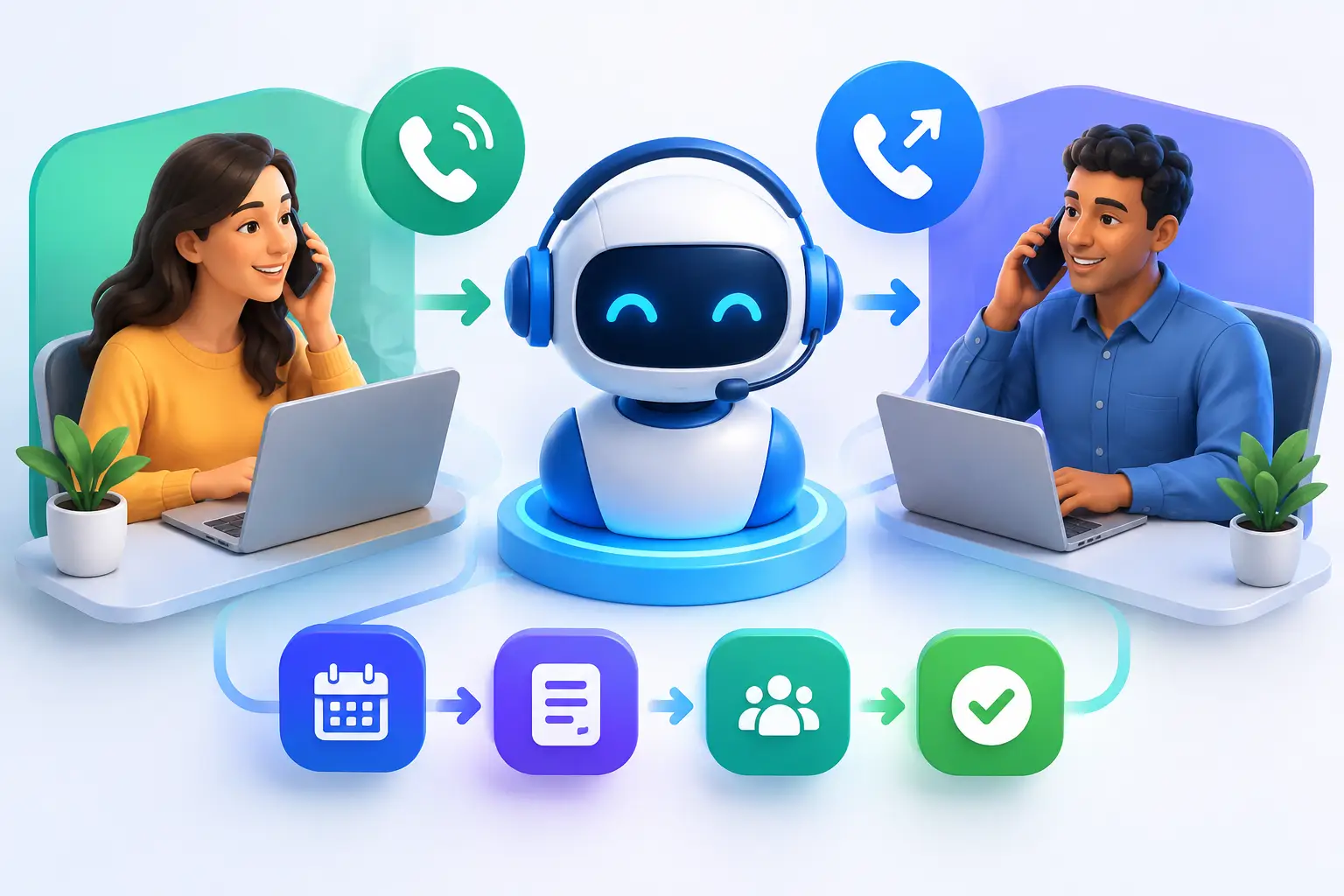
A candidate applies at 9:12 a.m. By 9:20, another applicant has applied, a hiring manager has changed the interview criteria, and your recruiter is already in a screening call. The bottleneck is not finding people to contact. It is responding, qualifying, documenting, and moving the right conversation to the next owner fast enough. Inbound outbound AI calling turns that repetitive phone work into a defined operating workflow.
For recruiting teams, that can mean an agent calls candidates, verifies role-critical details, records compensation expectations and notice periods, then books qualified people into an interview slot. For revenue and service teams, the same model answers incoming calls, identifies intent, handles routine questions, and routes urgent cases with context. The practical value is not that a system can talk. It is that every call produces a decision, a record, and a next action.
Inbound and outbound AI calling solve different gaps
Inbound calling begins when someone contacts your business. A prospect wants pricing, a candidate wants an update, a customer needs help, or a patient needs to book an appointment. The AI agent answers immediately, follows the approved call flow, captures the reason for the call, and either resolves the request or hands it to the right person.
Outbound calling begins with a defined list and a clear objective. The agent calls applicants who submitted CVs, leads that requested information, customers due for a follow-up, or contacts with an incomplete form. It asks structured questions, listens for qualifying signals, handles basic objections, and updates the underlying system after the conversation.
The two motions should work together, but they should not be configured as one generic script. An inbound caller may be frustrated, rushed, or unsure which department they need. An outbound recipient may not remember the form they completed or may be unavailable to talk. The opening, consent language, escalation rules, and success metric need to reflect that difference.
In recruiting, inbound AI calling can answer applicant status questions and capture reschedule requests. Outbound AI calling can screen every applicant against the same role requirements before a recruiter spends time on a live conversation. One protects responsiveness; the other protects recruiter capacity.
The workflow matters more than the voice
A natural-sounding voice is useful, but it is not the operating model. Teams get measurable results when calling is connected to reliable inputs, explicit decision rules, and documented outputs.
Start with the source record. For a hiring workflow, that record includes the CV, job description, must-have skills, seniority, location, shift requirements, compensation range, notice period, and disqualifying conditions. The AI operator should not begin with a blank slate. It should know what it is validating and what counts as a pass, a follow-up, or a handoff.
Then define the call script as a decision tree, not a monologue. A candidate may confirm five years of experience with a required technology but be unavailable for the stated start date. A lead may fit your target company profile but need a technical consultation rather than a sales pitch. The agent needs permission to take the correct route based on the answer, rather than forcing every caller through identical questions.
Finally, determine what happens after the call. A useful workflow creates structured fields, a transcript, a concise summary, outcome tags, and a next-step action. Qualified candidates receive a calendar invitation. A high-intent lead is assigned to an account executive with call notes. A support issue becomes a ticket with urgency and issue category already populated.
Without that final layer, AI calling simply creates more conversations for people to decipher later. With it, calls become operational data.
A recruiting example: from CV pile to booked interview
Consider a staffing team hiring 30 customer support representatives. The team receives 600 applications in a week. Reading every CV manually is slow, but keyword filtering is also unreliable. Someone may have relevant experience described in unexpected language, while another candidate may match the words without meeting the practical requirements.
A better sequence begins by parsing each CV against the role definition. The system identifies relevant experience, required skills, employment history, seniority, and possible gaps. It ranks candidates transparently, so recruiters can see why a profile is being prioritized rather than receiving an unexplained score.
The outbound agent then contacts candidates above the initial threshold. It can ask: Are you still interested? Are you available for the required shift? What is your current compensation expectation? When could you start? Can you describe the volume of customer requests you handled in your most recent role?
The value comes from verification. A CV is a claim. A structured conversation tests whether the claim is current, relevant, and compatible with the role. The agent captures answers in standardized notes, flags uncertainty when a response conflicts with the CV, and routes strong candidates to available interview slots.
Recruiters receive a shortlist with evidence: match score, transcript, call summary, compensation alignment, availability, and booking status. They are not starting from a pile of documents or replaying voicemail. They are reviewing qualified people who have already cleared the first operational checks.
Where teams get AI calling wrong
The most common mistake is automating a vague process. If the business cannot define what qualifies someone, who owns the next step, or when a human must intervene, the agent will expose that ambiguity at scale.
Another mistake is treating every completed call as a successful call. A high connection rate means little if the agent sends poorly qualified candidates to hiring managers or routes low-value leads to sales. Measure outcomes that connect to the workflow: qualified conversations, booked interviews, show rates, completed intake fields, time to first response, successful transfers, and recruiter hours removed from repetitive screening.
Teams also need sensible escalation boundaries. Sensitive employee relations issues, complex complaints, payment disputes, medical concerns, and requests requiring judgment should move to trained humans. An AI agent should make that handoff easier by collecting the right context first, not attempt to imitate authority it does not have.
Compliance deserves the same discipline. Calling rules, recording disclosures, consent requirements, time-zone restrictions, data retention, and opt-out handling vary by use case and jurisdiction. Configure these controls before a campaign launches, and keep an auditable record of what was said and what action followed. Speed is only useful when it remains controlled.
How to launch without a long implementation cycle
Begin with one high-volume, repeatable call type. In recruiting, this might be first-round screening for a role with stable requirements. In sales, it could be qualification for inbound demo requests. In service, it could be appointment confirmation and rescheduling.
Build the workflow around a small number of decisions. For example, a candidate may be qualified only when they meet skill, availability, compensation, and work authorization requirements. Anything unclear can be tagged for recruiter review rather than automatically rejected. This approach protects candidate experience while keeping the agent decisive.
Run a controlled sample before scaling. Review transcripts, compare agent outcomes against recruiter judgment, identify questions that create confusion, and inspect where callers abandon the conversation. Tune the script, routing rules, and opening language using actual call evidence.
Once the call flow is stable, connect it to calendars and CRM or applicant tracking records. The goal is not another isolated dialer. It is a workflow where an answer on the phone updates the record, triggers the correct follow-up, and gives the next human full context. Colleagu is built around this model: screen, verify, summarize, and schedule without forcing teams into manual data entry between steps.
The standard to hold an AI operator to
Inbound outbound AI calling should be judged like any other operational teammate. Does it respond on time? Does it follow the approved process? Does it collect accurate information? Does it escalate appropriately? Can managers see what happened without hunting through recordings and spreadsheets?
When the answer is yes, the phone stops being a queue of interruptions. It becomes a dependable channel for moving applicants, leads, customers, and appointments forward. Start with the calls your team repeats every day, make the decisions explicit, and let each completed conversation leave the operation clearer than it found it.