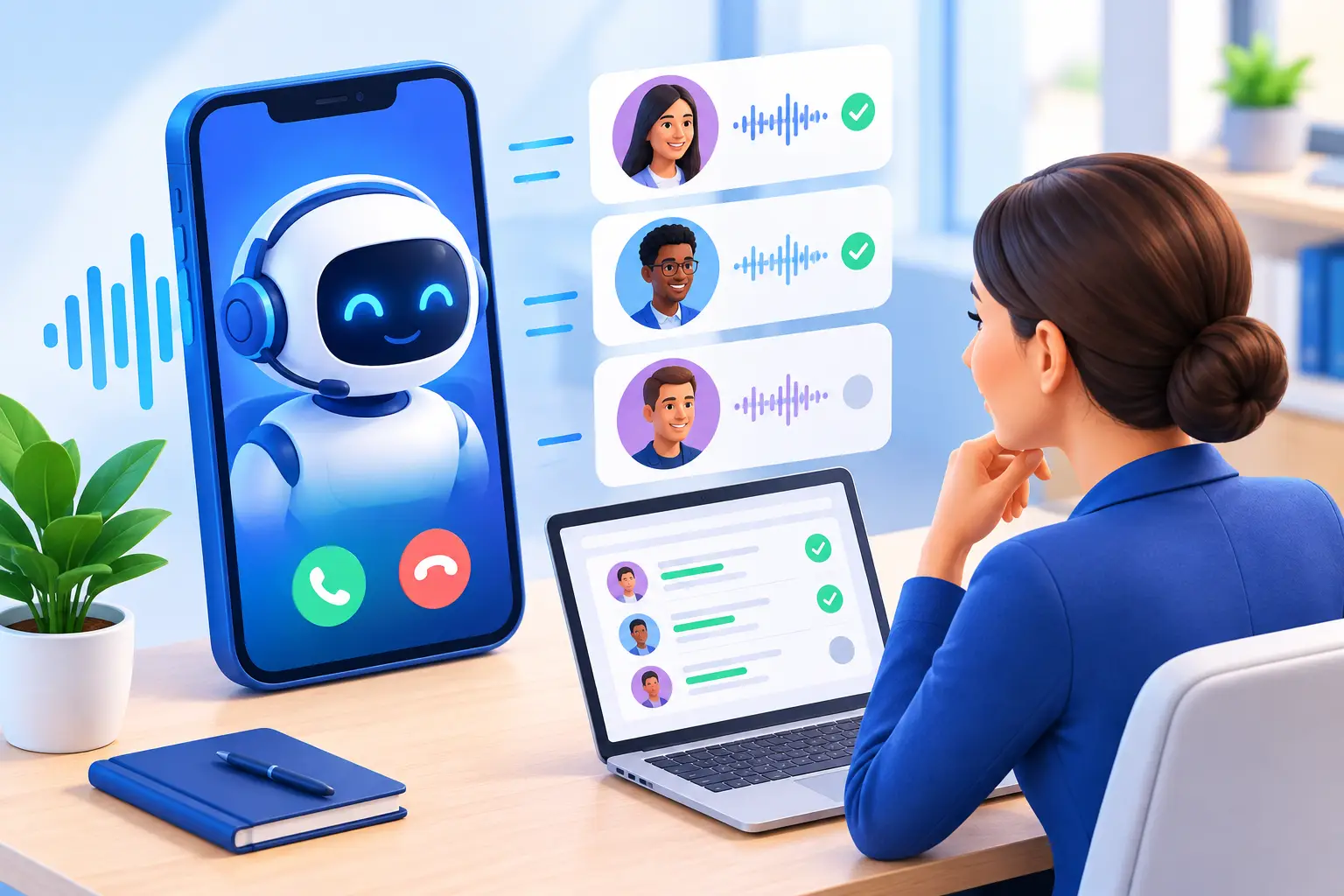
A candidate who looks strong on paper can still be unavailable for 60 days, outside the compensation range, unable to work the required schedule, or unclear on the experience listed on their resume. AI phone screening for recruiters handles those answers before a recruiter spends another 20 minutes on a first call.
That matters most when applicant volume is high and hiring managers need a credible shortlist now, not after a week of inbox triage. The objective is not to remove judgment from hiring. It is to give recruiters cleaner evidence, faster: who meets the non-negotiables, what they said in their own words, and which candidates are ready for a human conversation.
What AI phone screening actually does
An AI phone screener is a configurable voice agent that calls applicants, follows a structured screening script, understands responses, and records the outcome in a standardized format. It can ask about role-specific experience, work authorization, shift preferences, compensation expectations, location, notice period, and interest in the role. Based on the rules your team sets, it can qualify, disqualify, flag for review, or move a candidate directly to interview scheduling.
The distinction is operationally significant. Resume parsing tells you what the candidate submitted. A phone screen tests whether the person is reachable, interested, aligned on basics, and able to explain relevant experience. Used together, those signals are far more useful than keyword matching alone.
For a sales hiring team, the agent may ask candidates to describe quota ownership and outbound prospecting experience. For a frontline operations role, it may confirm weekend availability, commute distance, and required certifications. For technical hiring, it may validate a specific stack, seniority, work authorization, and salary expectations before a recruiter reviews the transcript.
The call should feel like an organized first conversation, not an interrogation. Candidates need a clear introduction, a concise explanation of the role, and a simple path to reach a human if they need accommodation or have a question the agent cannot answer.
Where AI phone screening for recruiters earns its place
The biggest gain is not simply fewer calls. It is parallel throughput.
A recruiter can usually screen one person at a time, while incoming applications continue to pile up. An AI operator can call and follow up with hundreds of applicants according to your outreach rules, including evenings or other candidate-friendly windows. It captures the same core data across every conversation, so the team is not comparing one recruiter's handwritten notes with another recruiter's memory of a rushed call.
This is especially valuable when time-to-contact affects acceptance rates. Candidates who apply to high-demand roles often receive outreach from several employers quickly. If your team waits two business days to make first contact, the strongest applicants may already be booked elsewhere. Fast outreach improves responsiveness, but only if it produces useful qualification data instead of a larger pile of unreviewed recordings.
A good workflow turns each call into a decision-ready record. That includes a transcript, a concise summary, answers to required questions, qualification status, and any concern that needs human review. The recruiter should be able to see why a candidate was advanced or held back, not just receive a black-box score.
Build the screening around decisions, not a generic script
The most common mistake is deploying a pleasant-sounding agent with a vague list of questions. That may generate calls, but it does not reliably move hiring forward. Start with the decision points that determine whether a candidate should reach a recruiter or hiring manager.
For each role, define the information that is required to advance, the answer ranges that are acceptable, and the cases that require a human exception. In practice, that means configuring the agent around details such as:
- Required skills, certifications, and years of relevant experience
- Compensation range and whether flexibility exists
- Start date, notice period, and ongoing availability
- Work location, travel, shift, or schedule requirements
- Work authorization and other role-specific eligibility checks
- Deal-breakers that should stop or route the process
Not every answer should be treated as a hard filter. A candidate whose salary expectation is slightly above range may still be worth a conversation if the role is difficult to fill. Someone without the preferred title may have directly relevant experience that a resume parser cannot fully interpret. Build those scenarios as review flags rather than automatic rejections.
The script also needs branching logic. If a candidate says they have five years of relevant experience, the agent should ask a meaningful follow-up: what did they own, what tools did they use, and what results did they deliver? If they say they are unavailable until next quarter, there is little value in continuing through ten more questions for an urgent opening. Good voice screening is structured, but it should not be rigid.
From CV pile to booked interviews
A high-performing workflow connects four stages: intake, outreach, validation, and routing.
First, the system reads the job requirements and candidate resumes. It extracts relevant skills, seniority, employment history, compensation signals where available, and gaps against the role. This creates an initial ranking, but ranking is only the starting point.
Next, the voice agent contacts selected candidates. It introduces the opportunity, confirms interest, and asks the configured questions. If someone does not answer, the workflow can attempt follow-up according to your contact policy rather than leaving the recruiter to manually track callbacks.
Then comes validation. The agent compares what the candidate says with the CV and role criteria. A mismatch does not automatically mean dishonesty. Job titles vary, resumes are often simplified, and candidates may explain their scope more clearly in conversation. But discrepancies should be visible. For example, a resume may imply management experience while the call reveals that the candidate supported a manager without direct reports. That is useful evidence for the recruiter.
Finally, qualified candidates are routed. For a straightforward role, the agent can offer available interview slots and book directly into the team's calendar. For more nuanced searches, it can send the recruiter a scored profile with transcript excerpts and a recommendation to review. The right endpoint depends on the cost of a false positive, the seniority of the role, and how much discretion the hiring team wants at this stage.
Colleagu is designed around this operating model: read every CV, call to qualify, document the evidence, and route the next action without forcing recruiters to assemble the workflow across disconnected tools.
Keep recruiters in control of the exceptions
Automation works best when the boundaries are explicit. Recruiters should retain control over the question set, qualification criteria, calling windows, handoff rules, and calendar access. They also need a clear path to intervene when a candidate has an unusual background, asks for a human, or needs an accommodation.
This is not only a candidate-experience issue. It is a quality-control issue. Screening criteria can drift when teams copy old templates or when requirements change after a hiring manager recalibrates the role. Review call outcomes regularly, especially during the first weeks of a new workflow. Look for candidates who were incorrectly screened out, questions that produce vague answers, and stages where the agent is sending too many people to recruiters.
Compliance deserves the same level of operational attention. Use approved disclosure language, honor consent and contact preferences, follow applicable calling rules, and define retention practices for call recordings and transcripts. Work with your legal and HR teams on the policies that apply to your locations and hiring process. An AI agent can make screening more consistent, but it does not eliminate the need for accountable process design.
Measure quality, not just calls completed
Call volume is easy to report and easy to overvalue. The better measures show whether the workflow improves hiring throughput without lowering the bar.
Track contact rate, completion rate, candidate-to-recruiter pass rate, and time from application to first meaningful conversation. Then measure the downstream results: interview attendance, hiring-manager approval, offer rate, and early retention where enough data exists. If the agent books more interviews but hiring managers reject most of them, the qualification logic needs adjustment. If it screens out candidates who later become strong hires through manual review, your filters may be too strict.
Candidate feedback matters, too. A short, direct screen can feel more respectful than repeated voicemails and delayed responses. But a poorly configured agent that asks irrelevant questions or cannot explain the role will create friction quickly. Review transcripts as part of your weekly operating rhythm. They reveal where the script is working and where it is losing trust.
The most effective AI phone screen does not try to impersonate a recruiter. It handles repeatable qualification work with speed and consistency, then gives recruiters the context to make the judgment calls that actually require them. Set the rules clearly, inspect the evidence, and let every qualified conversation move one step closer to a real interview.